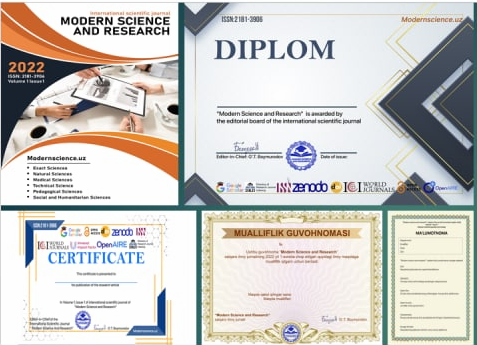
International scientific journal "Modern Science and Research"

ISSN: 2181-3906;   OAV Guvohnoma №042359;   Impact factor (UIF-2022): 8.2
Ushbu jurnalda O'zbekiston va chet davlatlar olimlari ilmiy maqolalari chop etiladi.
Ushbu jurnal OAK ro'yxatida mavjud xalqaro bazalarda indekslanib, elektron va bosma holatda nashr etib boriladi.
Jurnalning rasmiy tillari: o‘zbek, rus, ingliz
Jurnal telegram kanali: https://t.me/modernscience_research
Maqola muallifiga BEPUL qabul qilinganlik haqida tabriknoma, sertifikat, indekslanganligi haqida ma'lumotnoma va mualliflik guvohnomasi beriladi.
Jurnal har oyda nashr qilinadi.
Maqolalar yuborish uchun: @modernscience_research
golibboymurodov6@gmail.com

Articles Information letter

Oxirgi qushilgan maqolalar:


FOLK ORAL ART AND ITS INDIVIDUAL CHARACTERISTICS

This article discusses folk oral culture and its specific features.


16.06.2025 Volume 4 Issue 6 View more Download
BOLALAR RIVOJLANISHIDA DIDAKTIK O‘YINLARNING AHAMIYATI

Ushbu maqolada didaktik o‘yinlarning bolalar rivojlanishidagi ahamiyati yoritilgan. Xususan, o‘yinlar orqali bolalarning bilish faoliyati, nutqi, tafakkuri, xotirasi va emotsional salohiyati qanday shakllanishi tahlil etilgan. Maqolada turli yosh guruhlariga mos didaktik o‘yin turlari, ularning pedagogik maqsadlari va samaralari misollar bilan asoslab berilgan. Shuningdek, zamonaviy texnologiyalarga asoslangan interaktiv o‘yinlarning ta’limdagi o‘rni va natijadorligi amaliy tajribalar asosida ko‘rsatib o‘tilgan.


16.06.2025 Volume 4 Issue 6 View more Download
RANGTASVIRDA NUR VA SOYA SIMFONIYASI

Mazkur maqolada rangtasvir san’atida nur va soya vositalarining badiiy hamda dramaturgik ifodaviy kuchi tahlil qilinadi. Nur va soyaning psixologik obraz yaratishdagi o‘rni, tenebrizm uslubining qadimiy va zamonaviy san’atdagi talqinlari, shuningdek, yorug‘lik kontrasti orqali kompozitsion yechimga erishish yondashuvlari yoritiladi.


16.06.2025 Volume 4 Issue 6 View more Download
SELECTING AND JUSTIFYING DEEP LEARNING MODELS FOR EMOTION CLASSIFICATION

This paper focuses on the selection and justification of deep learning models for emotion classification tasks. It provides a comprehensive analysis of various neural network architectures, including Convolutional Neural Networks, Recurrent Neural Networks, Long Short-Term Memory networks, and Transformer models, assessing their performance in recognizing and classifying human emotions from multimodal data sources. The study examines the strengths and limitations of each model with respect to data type, training efficiency, computational complexity, and generalization capabilities. Furthermore, criteria for optimal model selection tailored to real-world emotion recognition applications are discussed. The findings contribute to enhancing the accuracy and robustness of emotion classification systems and offer valuable guidelines for researchers and practitioners developing advanced affective computing solutions.


12.06.2025 Volume 4 Issue 6 View more Download
MODERN APPROACHES IN CHILDREN'S HEALTH WITH STRESS RELATED HEADACHES

This scientific work explores the clinical features, causes, and contemporary treatment strategies for tension-type headache in children, one of the most prevalent and often underdiagnosed neurological conditions in the pediatric population. The study highlights the multifactorial origin of tension-type headache, emphasizing psychological stress, musculoskeletal strain, and lifestyle imbalances as central contributing factors. Special attention is given to the importance of early diagnosis based on clinical evaluation, patient history, and the use of structured assessment tools designed for children. The research reviews both pharmacological and non-pharmacological treatment approaches, with a focus on behavioral therapy, cognitive-behavioral interventions, physical therapy, and biofeedback techniques. Preventive strategies such as stress management, sleep hygiene, physical activity, and nutritional regulation are also discussed as key elements in reducing the frequency and severity of headache episodes. Furthermore, the work highlights the psychosocial impact of chronic headache on children’s academic performance, emotional health, and social development.


12.06.2025 Volume 4 Issue 6 View more Download
Telegram ZENODO OpenAire Copernicus Cyberleninka Google Scholar Impact Factor