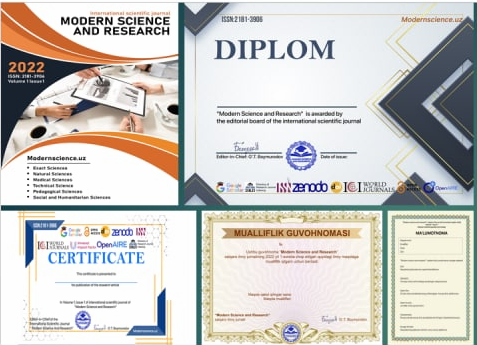
International scientific journal "Modern Science and Research"

ISSN: 2181-3906;   OAV Guvohnoma №042359;   Impact factor (UIF-2022): 8.2
Ushbu jurnalda O'zbekiston va chet davlatlar olimlari ilmiy maqolalari chop etiladi.
Ushbu jurnal OAK ro'yxatida mavjud xalqaro bazalarda indekslanib, elektron va bosma holatda nashr etib boriladi.
Jurnalning rasmiy tillari: o‘zbek, rus, ingliz
Jurnal telegram kanali: https://t.me/modernscience_research
Maqola muallifiga BEPUL qabul qilinganlik haqida tabriknoma, sertifikat, indekslanganligi haqida ma'lumotnoma va mualliflik guvohnomasi beriladi.
Jurnal har oyda nashr qilinadi.
Maqolalar yuborish uchun: @modernscience_research
golibboymurodov6@gmail.com

Articles Information letter

Oxirgi qushilgan maqolalar:


PEDAGOGICAL CRITERIA FOR THE FORMATION OF AN AXIOLOGICAL WORLDVIEW IN SCHOOLCHILDREN

This article analyzes the spiritual and moral characteristics of schoolchildren and provides information about the pedagogical criteria for educating young people in the context of a modern axiological approach to pedagogy. Based on the results of our research, the novelty of the pedagogical phenomenon is that the main goal is to strengthen national values, which characterize the specific features of the implementation of the axiological approach, and to focus on the education and upbringing of young people, increasing their worldview. It is to educate young people as a spiritually and morally mature, harmonious generation while preserving the intellectual identity of the younger generation as a strategic resource for society and the whole state.


12.04.2025 Volume 4 Issue 4 View more Download
SPORT METROLOGIYASIDA TELEKOMUNIKASIYA VOSITALARNING QO'LLANISHI

Maqolada yurak urishi va nafas olishning doimiy monitoringi orqali patsientlarning fiziologik holatini dinamikada o'rganish uchun o'lchash tizimi кўриб чиқилган. Fiziologik holat sensorlari sifatida puls sensori va nafas olish sensorini qollanilgan.


12.04.2025 Volume 4 Issue 4 View more Download
CHALLENGES AND LEGAL PROTECTIONS: WOMEN'S RIGHTS IN INDIA AND AFGHANISTAN

A comparative review is presented of the legal frameworks and societal challenges that mold women's rights in India and Afghanistan, respectively. Despite this fact, both countries have legislation that empowers them, though in practice, their enforcement remains faced with deep- rooted cultural mores and socio-political reasons. The article discusses some of the key legal provisions, including constitutional guarantees of gender equality in India and Afghanistan. The paper argues, with case studies, the divergence between legal theory and practice that has occurred in both countries, along with how such a gap might be bridged through legal reform, a change in societal values, and much-needed international cooperation. The article concludes by providing recommendations for strengthening legal frameworks and promoting gender equality through both legal and societal efforts.


12.04.2025 Volume 4 Issue 4 View more Download
STUDY OF FALSE TESTIMONY (PERJURY) IN THE CRIMINAL JUSTICE SYSTEM OF AFGHANISTAN

False testimony is considered one of the significant challenges in the judicial system of Afghanistan, having widespread negative impacts on the implementation of justice. This article explores the concept, elements, and penalties for false testimony in Hanafi jurisprudence and the Afghanistan’s Penal Code. According to findings, in Hanafi jurisprudence, false testimony is regarded as a major sin, with penalties such as public humiliation, flogging, and imprisonment prescribed for it. In the Afghanistan criminal justice system, false testimony is also defined as a crime with punishments such as imprisonment, fines, and the imposition of penalties on the false witness based on its impact on the proceedings. The aim of this research is to clarify and examine the crime of false testimony in the Afghanistan’s criminal justice system and to seek answers regarding what constitutes false testimony within this system. The research method employed in this article is fundamental, with information gathered using a descriptive-analytical approach and through library research. The results indicate that Afghan legislators largely follow the views of Imam Abu Yusuf and Muhammad, students of Imam Abu Hanifa, and have attempted to prevent the proliferation of this phenomenon through legal measures. The similarities of this crime in Hanafi jurisprudence and Afghanistan’s criminal law include legal and jurisprudential foundations, attention to the effects of false testimony, penalties for false testimony, and the nature of the crime of false testimony. The differences include the legal approach versus the jurisprudential approach, occurrence only in court sessions versus occurrence in court sessions and before judicial officers, differences in the severity of penalties, civil and criminal liability, and how to deal with false testimony after a verdict is issued.


12.04.2025 Volume 4 Issue 4 View more Download
THE IMPLEMENTATION OF THE RULE OF DAR- AL-HUDUD FI AL-SHUBUHAT IN SUNNI JURISPRUDENCE AND ITS PENAL CONSEQUENCES IN THE PENAL CODE OF AFGHANISTAN (A CASE STUDY OF THE THEFT CRIME)

One of the categories of Sharia crimes is the Hudud crimes. By consensus among Sunni jurists, theft is classified as a Hudud crime, for which the prescribed punishment is amputation of the hand. However, in certain cases, the implementation of the punishment for theft is suspended, particularly when there is doubt regarding the crime's occurrence. Based on a Hadith of the Prophet Muhammad (peace be upon him), Hudud are not implemented in cases of doubt. In such instances, the offender will be punished according to the Penal Code of Afghanistan, specifically referencing Article 2, Paragraph 1, and Article 699, Paragraph 2. This research aims to clarify the foundation and application of the rule of Dar- al-Hudud in the context of theft according to Sunni jurisprudence and to examine its penal consequences in the Afghanistan’s Penal Code. The significance of this research lies in its first step of outlining the applications of this rule, which includes the conditions for the suspension of the punishment for theft in Sunni jurisprudence, and examining the penal consequences for the offender based on the Afghanistan’s Penal Code. In the second step, while applying this rule to the crime of theft and the Afghanistan’s Penal Code, it aims to free the reader from the need to reference other sources, which are mostly in Arabic. Additionally, it is crucial for defense attorneys when preparing defenses, for prosecutors when drafting charges, and for judges during hearings and rulings. The methodology used in this research is descriptive-analytical, utilizing library resources. This study will clarify the terms used in the title and discuss the applications of this rule, including: wrongful appropriation of property, embezzlement, denial of deposit, theft of the Quran, burial shrouds, low-value items, theft not from a secured location, theft from places of worship, etc. In such cases, the punishment for theft is not implemented, and the offender is penalized according to the Afghanistan’s Penal Code.


12.04.2025 Volume 4 Issue 4 View more Download
Telegram ZENODO OpenAire Copernicus Cyberleninka Google Scholar Impact Factor